Leaf-on vs leaf-off imagery for canopy height mapping in mixed hardwood stands
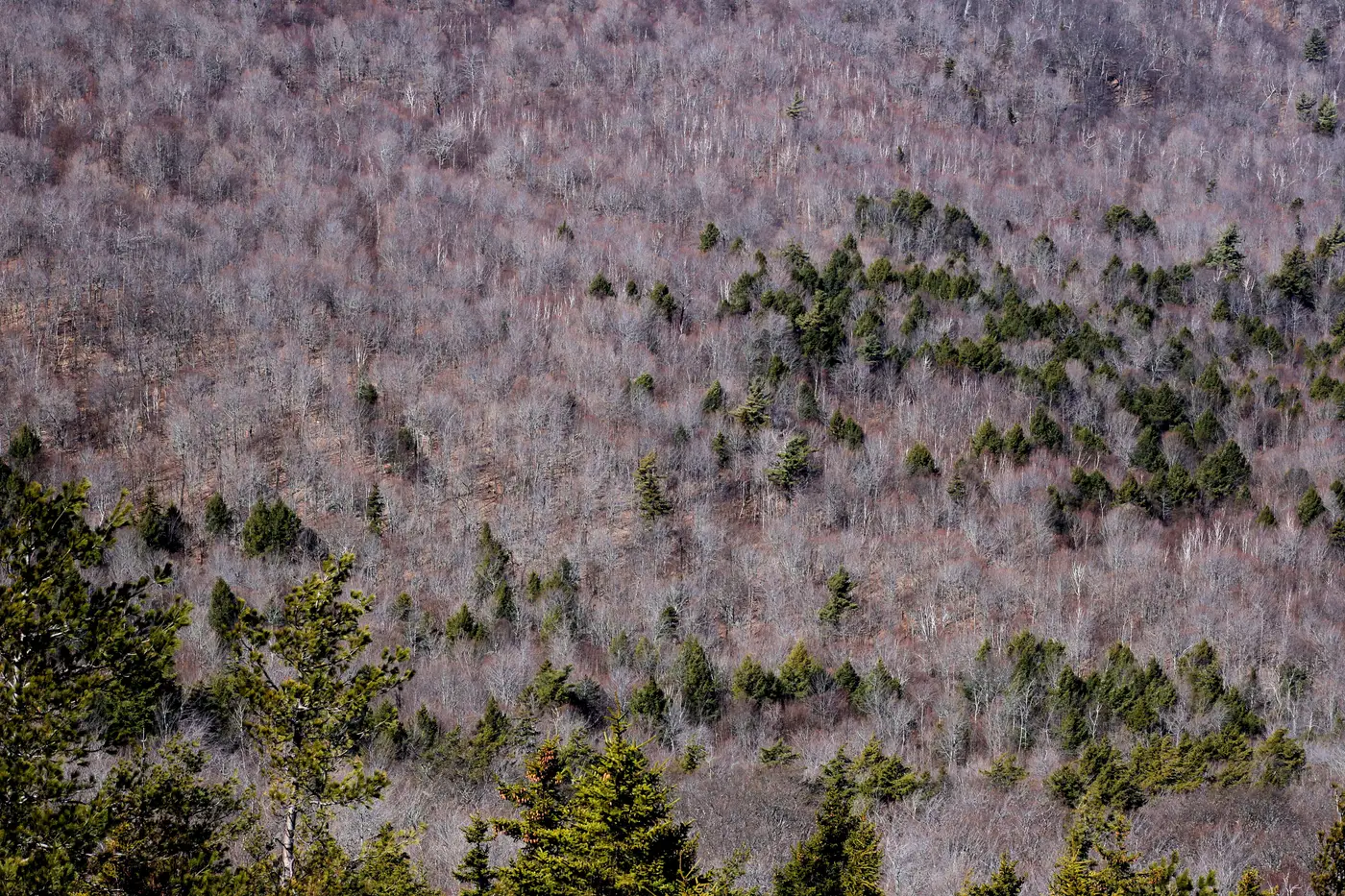
For a conifer plantation, flight timing is mostly a question of sun angle and cloud cover. Mixed hardwood stands are a different problem: the leaf is on the tree or it isn't, and that single fact changes what a stereo pair can resolve on the ground. Here's what changes crown by crown, and why it matters for a standing-volume number.
What the stereo pair sees in each state
In leaf-off conditions, the camera looks mostly through a hardwood crown to stem and branch structure. A stereo match against that open canopy produces a thin, skeletal surface, closer to a wireframe than a shell. That's good for terrain work: the correlation algorithm has a real shot at finding bare ground, or close to it, between the branches, especially on drier upper slopes with thin shrub cover. It's not good for volume, because the crown that's intercepting light and putting on wood this growing season is barely represented in that surface.
In full leaf-on, closed-canopy conditions, the stereo pair sees the crown the way the stand is using it this season: closed, lobed, overlapping with its neighbors. That closed surface is what a standing-volume regression wants, because crown closure and canopy height correlate with volume in a way bare branch structure doesn't. The tradeoff is the ground. Under full leaf-out, the optical pair sees the top of the canopy and nothing underneath. There's no bare-earth return to subtract.
The two-pass answer most mixed hardwood programs land on
A canopy height model is a subtraction: canopy surface minus ground surface. Because optical stereo can't see through a closed hardwood crown, a program covering mixed hardwoods usually has to settle the ground question once, with a leaf-off pass or an existing bare-earth source, and then hold a consistent leaf-on window for the canopy surface that gets re-flown and re-differenced year over year. The ground doesn't move much between growing seasons. The canopy does, and that's the layer the volume estimate depends on.
Picking the flying window
The target is peak leaf-out, before any early species in the stand start dropping. Species run on different clocks. In an oak-hickory-maple stand, maple can be visibly thinning while oak is still fully closed. The practical window is the stretch where the slowest species to leaf out is still fully in, which in a lot of temperate latitudes lands mid-summer, though the exact weeks shift with elevation and stand composition. A project team should scope this by hand against the stand's own species mix rather than borrow a flying date from a different latitude.
Why accuracy comes from the window, not the sensor spec
Flying tight and consistent on the window matters more than chasing a theoretically perfect week, because the accuracy of a deciduous canopy surface model has less to do with ground sample distance than with hitting the same point on the closure curve every year. A stand flown at roughly 70 percent leaf-out one year and fully closed the next will show an apparent height and volume jump that has nothing to do with wood actually added. For a one-off appraisal map, that kind of timing slop is tolerable. For an annual standing-volume layer feeding a carbon project's re-measurement cycle, it isn't: the real growth signal between years can be smaller than the signal you'd introduce by flying three weeks early or late. Locking the window is a measurement-integrity decision as much as a photogrammetry one.
That's the discipline behind the annual canopy surface and standing-volume layer built from overlapping VHR stereo passes: the same flying window, the same species-closure target, holding stand after stand and year after year. If a program's mixed hardwood acreage needs that kind of consistency written into the acquisition plan, that's where to start the conversation.